ai-ledger
Version Control for Accountants in the AI Era
A six-part PythonMuse series on why version control becomes mandatory once AI enters finance workflows — and what it actually looks like in practice.
PythonMuse LLC Series launch · 2026
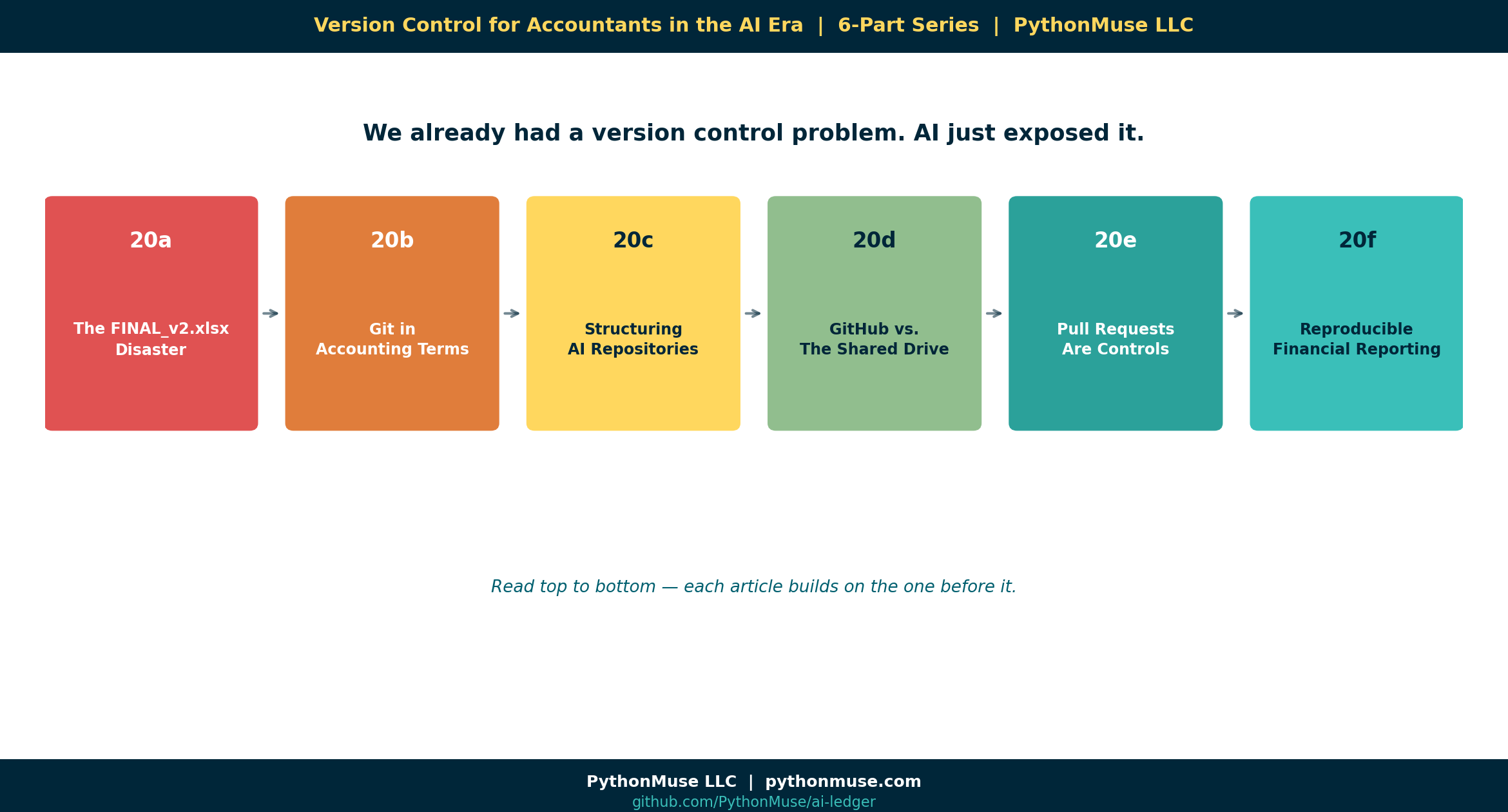
The Series in One Line
We already had a version control problem. AI just exposed it.
For decades, accountants have managed change with file names like Budget_FINAL_v2_REAL_USE_THIS_ONE.xlsx. That was awkward, but survivable. Then AI dropped the change-velocity of finance workflows by an order of magnitude — and the shared drive stopped being able to keep up.
This series walks accounting and finance professionals from “what is Git?” to reproducible, audit-ready, AI-era financial workflows — using analogies, light humor, and zero pressure to become a software engineer.
The Six Articles
| # | Title | What you’ll get out of it |
|---|---|---|
| 20a | The FINAL_v2.xlsx Disaster: Why AI Makes Version Control Mandatory for Accountants | The emotional hook. The problem named. |
| 20b | Git Explained Using Accounting Terms | The Rosetta Stone — every Git word in accounting language. |
| 20c | How Finance Teams Should Structure AI Repositories | A folder layout you can adopt next Monday. |
| 20d | GitHub vs. The Shared Drive | Side-by-side. The eight-second audit answer. |
| 20e | Pull Requests Are Internal Controls | The governance article. Map PRs to COSO. |
| 20f | Reproducible Financial Reporting: Where Finance Is Heading | The vision close. “Rerun the workflow.” |
Each article is short (~4–6 min read), light in tone, and paired with a planned companion video.
A Framework, Not a Tool
Every article carries the same reminder:
🛠️ This is a framework, not a product pitch.
We use Git + GitHub in this series because they’re free, popular, and have the friendliest UI for non-engineers. But every concept — repos, commits, branches, PRs, tags — has a direct equivalent in Azure DevOps Repos and AWS CodeCommit. Pick what your IT team already uses. The framework doesn’t change.
Who This Series Is For
- Controllers and accounting managers trying to figure out how AI fits into close.
- Senior accountants who keep getting handed AI-generated scripts and don’t know how to govern them.
- Internal auditors who need to ask the right questions about reproducibility.
- Anyone tired of
FINAL_v2_REAL_USE_THIS_ONE.xlsx.
You will not need to:
- Install anything before you read.
- Use a terminal.
- Become a developer.
You will leave with:
- A new vocabulary.
- A defensible folder structure.
- A clear mental model for AI-era internal controls.
- One repo you can fork and learn from.
How to Read This Series
In order, top-to-bottom, is best. Each article assumes you’ve read the previous one. But if you only have time for two:
- Start with 20a (the emotional hook).
- Then jump to 20e (the governance payoff).
The rest will pull you in.
Related Reading Across PythonMuse
This series weaves together threads from across the catalog. Articles you’ll see cross-referenced inside it include:
- Reproducible Accounting
- AI Governance for Controllers
- When to Trust AI to Run Your Accounting Workflows
- Zero Trust AI Accounting
- Skills and Agents for Accountants
- Your First CLAUDE.md
- The Workings Layer Method
- What the Heck Is a Script?
- When Your AI Enters Month-End Close Mode
A note on how this series was made. This series started with me. The pain, the analogies, and the series shape are mine — they came out of years of watching accountants try to govern AI workflows on top of shared drives that were never built for the job. GitHub Copilot (Claude Sonnet 5 and Opus 4.7) then built the final articles, the hub, and all visual concepts — working from my direction and feedback at each step. I reviewed every output, pushed back on things I didn’t like, and made all final content decisions. That process — bringing your own experience, using AI to build and iterate, and staying in the editorial seat throughout — is exactly what this series is about.
By Svetlana Toohey