ai-ledger
Version Control for Accountants in the AI Era
A six-part PythonMuse series on why version control becomes mandatory once AI enters finance workflows — and what it actually looks like in practice.
PythonMuse LLC Series launch · 2026
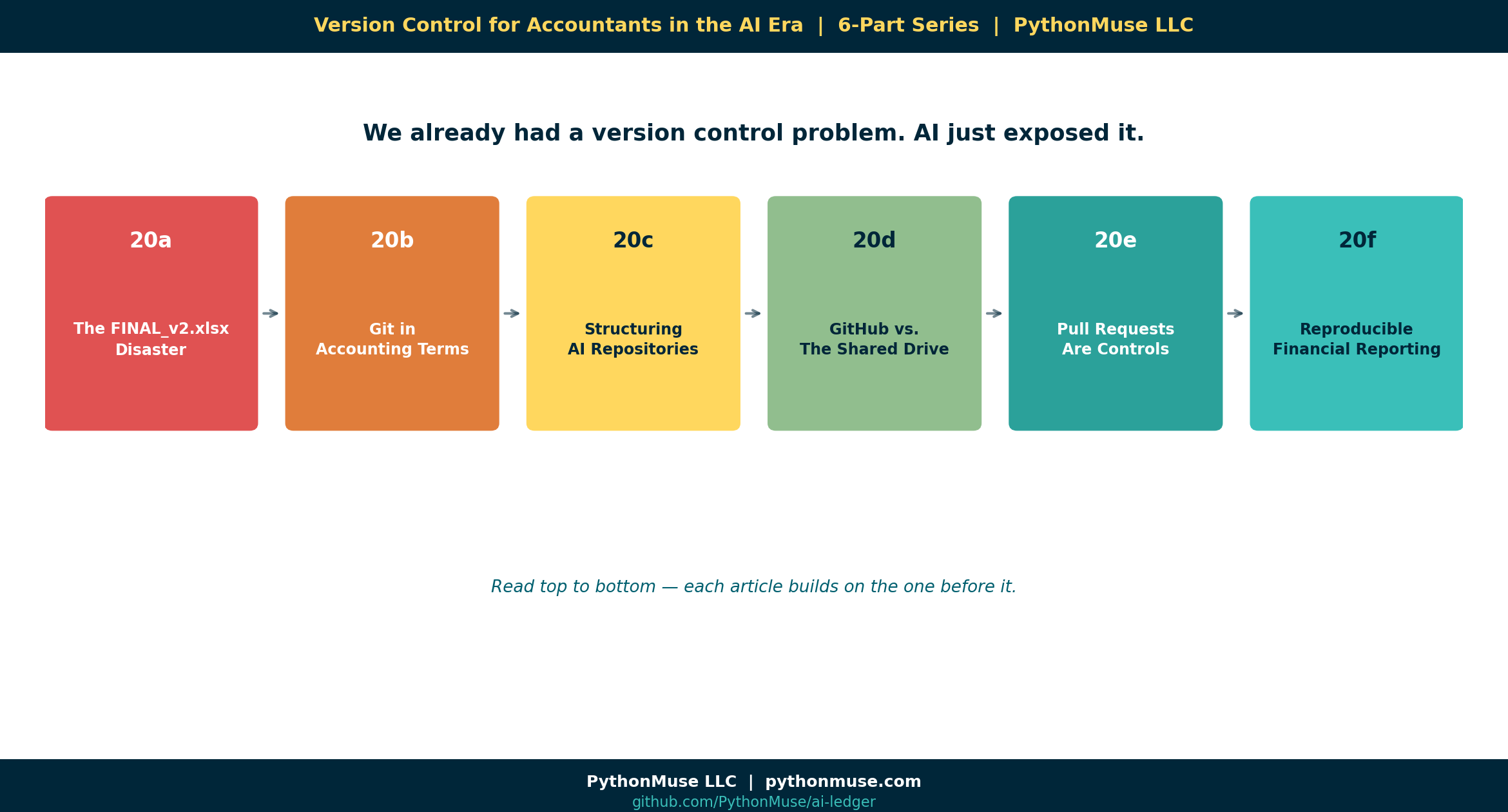
The Series in One Line
We already had a version control problem. AI just exposed it.
For decades, accountants have managed change with file names like Budget_FINAL_v2_REAL_USE_THIS_ONE.xlsx. That was awkward, but survivable. Then AI dropped the change-velocity of finance workflows by an order of magnitude — and the shared drive stopped being able to keep up.
This series walks accounting and finance professionals from “what is Git?” to reproducible, audit-ready, AI-era financial workflows — using analogies, light humor, and zero pressure to become a software engineer.
The Six Articles
| # | Title | What you’ll get out of it |
|---|---|---|
| 20a | The FINAL_v2.xlsx Disaster: Why AI Makes Version Control Mandatory for Accountants | The emotional hook. The problem named. |
| 20b | Git Explained Using Accounting Terms | The Rosetta Stone — every Git word in accounting language. |
| 20c | How Finance Teams Should Structure AI Repositories | A folder layout you can adopt next Monday. |
| 20d | GitHub vs. The Shared Drive | Side-by-side. The eight-second audit answer. |
| 20e | Pull Requests Are Internal Controls | The governance article. Map pull requests (PRs) to COSO. |
| 20f | Reproducible Financial Reporting: Where Finance Is Heading | The vision close. “Rerun the workflow.” |
Each article is short (~4–6 min read), light in tone, and paired with a planned companion video.
A Framework, Not a Tool
Every article carries the same reminder:
🛠️ This is a framework, not a product pitch.
We use Git + GitHub in this series because they’re free, popular, and have the friendliest UI for non-engineers. But every concept — repos, commits, branches, PRs, tags — has a direct equivalent in Azure DevOps Repos, AWS CodeCommit, GitLab, and Bitbucket. Pick what your IT team already uses. The framework doesn’t change. Every article in this series repeats this reminder briefly and links back here — this is the one place it’s spelled out in full.
📎 Quick definition: repository (“repo”). A repository is a project’s whole folder, plus a complete, permanent record of every change ever made inside it. Every Git term used across this series — repo, commit, branch, PR, tag — gets its own plain-English, accounting-flavored translation in Article 20b.
Who This Series Is For
- Controllers and accounting managers trying to figure out how AI fits into close.
- Senior accountants who keep getting handed AI-generated scripts and don’t know how to govern them.
- Internal auditors who need to ask the right questions about reproducibility.
- Anyone tired of
FINAL_v2_REAL_USE_THIS_ONE.xlsx.
You will not need to:
- Install anything before you read.
- Use a terminal (also called the “command line”) — if you don’t know what that is, don’t worry, you won’t need one for anything in this series.
- Become a developer.
You will leave with:
- A new vocabulary.
- A defensible folder structure.
- A clear mental model for AI-era internal controls.
- One repo you can fork and learn from.
How to Read This Series
In order, top-to-bottom, is best. Each article assumes you’ve read the previous one. But if you only have time for two:
- Start with 20a (the emotional hook).
- Then jump to 20e (the governance payoff).
The rest will pull you in.
Related Reading Across PythonMuse
This series weaves together threads from across the catalog. Articles you’ll see cross-referenced inside it include:
- Reproducible Accounting
- AI Governance for Controllers
- When to Trust AI to Run Your Accounting Workflows
- Zero Trust AI Accounting
- Skills and Agents for Accountants
- Your First CLAUDE.md
- The Workings Layer Method
- What the Heck Is a Script?
- When Your AI Enters Month-End Close Mode
A note on how this series was made. This series started with me. The pain, the analogies, and the series shape are mine — they came out of years of watching accountants try to govern AI workflows on top of shared drives that were never built for the job. GitHub Copilot (Claude Sonnet 5 and Opus 4.7) then built the final articles, the hub, and all visual concepts — working from my direction and feedback at each step. I reviewed every output, pushed back on things I didn’t like, and made all final content decisions. That process — bringing your own experience, using AI to build and iterate, and staying in the editorial seat throughout — is exactly what this series is about.
By Svetlana Toohey
© 2026 PythonMuse LLC. Content licensed under CC BY-NC-SA 4.0; code licensed under MIT.